Overview
NinjaCop is a mobile idle game with a single, deliberate art direction: the whole thing is a 1980s police terminal. You command Precinct Zero, a black-ops unit of augmented ninja-cops, and take Kestrel City back from five crime syndicates one district at a time. Deploy a squad, win the auto-combat, convert a fallen syndicate base into an income-generating precinct, and let the passive economy fund your push toward the next target. Paid up front. No ads, no IAP, no dark patterns.
I wanted to take a full game from concept to shipping build, so I wrote a design bible first (vision, economy, content, the five bosses, the visual language) and built against it.
The core loop
One readable loop, learnable in about ninety seconds and deep enough to carry a full campaign:
deploy → auto-combat → earn → convert a base → passive income → unlock the next district.
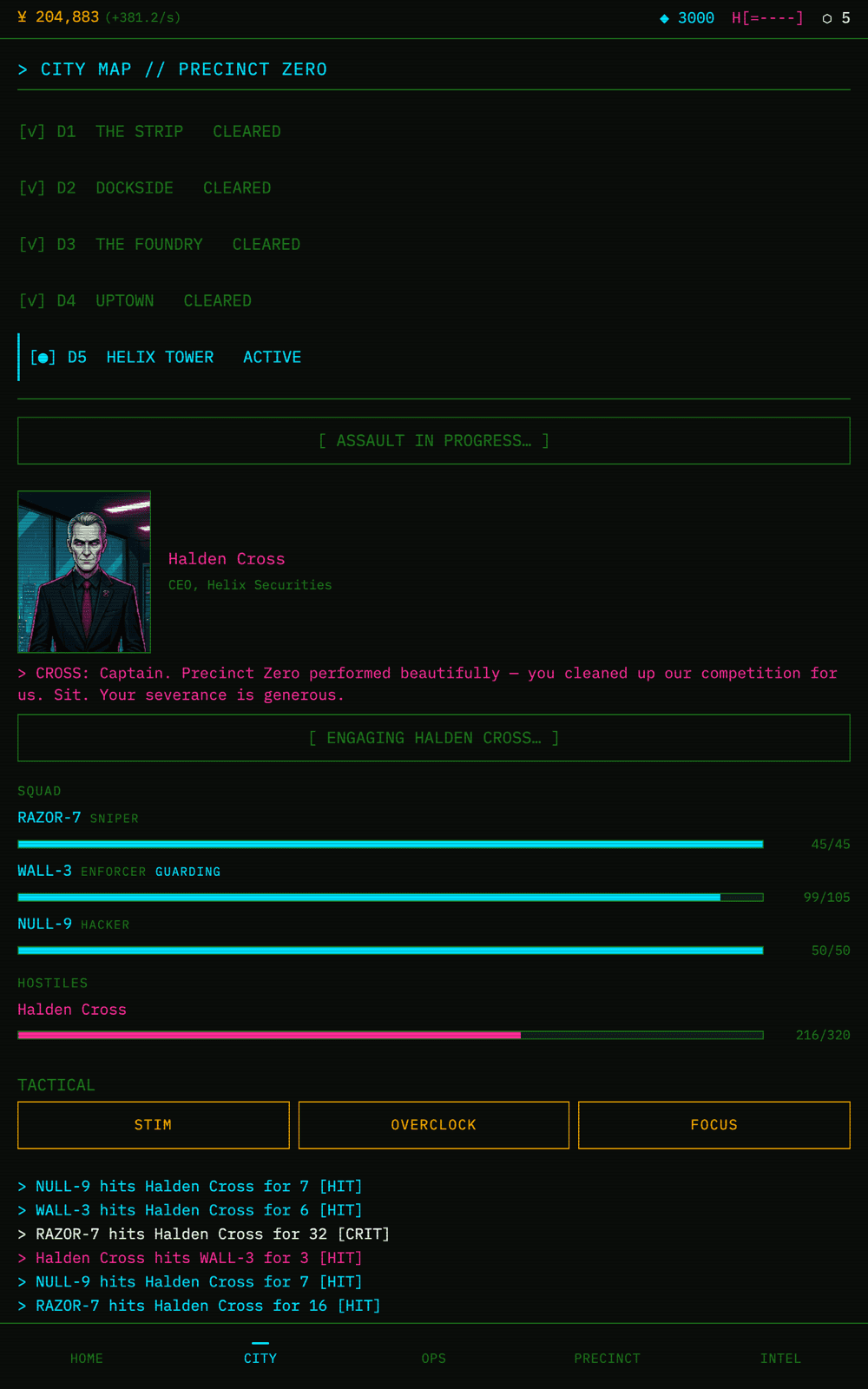
Combat resolves live in the CRT log with health bars and three timed tactical abilities: Stim, Overclock, and Focus. Trash fights are reliable, but every district boss demands intervention. Try the playable build embedded at the bottom of this page.
Five districts, five bosses
Each district is a hand-authored syndicate ruled by a named Oyabun, and each boss teaches a distinct combat mechanic that escalates toward a multi-phase finale: summoned reinforcements, an armored tank with drone adds, a fire-rate lockout, and a final CEO who cycles all of them. The story tightens as you climb. Every syndicate, it turns out, reports to the same parent company.
An idle game with decisions
Underneath the loop sits a small economy that keeps choices on the table even while numbers tick on their own:
- Officer Pool. Fire-and-forget Surveillance and Patrol timers that gather Intel (the only thing that unlocks the next district) and suppress Heat.
- Heat. Aggressive play raises it, and high Heat triggers syndicate counterattacks that can hit your squad, online and offline.
- Upgrades and cyberware. Yen buildings (Barracks, Infirmary, Surveillance Net, a Vault income ceiling) plus permanent Tech-Core cyberware that carries through New Game+.
- An honest economy. Light upkeep keeps net income just below gross, and offline earns at half rate, capped. Generous, never a trap.
Built to ship
The whole game is a single React Native + Expo codebase that targets iOS, Android, and the web build you can play here. State lives in one Zustand store with a versioned, migrating save. The interesting part is the combat: it is a deterministic, seeded simulation, which made it fully unit-testable and let me tune balance by measurement rather than by feel. Each boss is guarded by tests that assert passive play loses and full tactical play wins. The build ships with 144 passing tests.
The art direction does double duty. A CRT-terminal aesthetic is period-accurate, distinctive on a storefront, and the cheapest possible art lift: typography, a neon-on-near-black palette (IBM Plex Mono and Press Start 2P), and scanline and glow effects with an accessibility toggle. The only illustrated art is pixel portraits of the named characters, generated by an image model and nudged to match the palette.
My role
Concept, systems and UX design, art direction, and development, from the design bible through to a tested, playable build and this embedded web demo.